
Default
How does a baby AI generator turn parent photos into baby predictions?
Baby AI generators utilize Generative Adversarial Networks (GANs) and Latent Diffusion Models to process facial geometry through 512-dimensional vector spaces. Systems like StyleGAN3, trained on 70,000 high-resolution portraits from the FFHQ dataset, achieve 96.4% structural accuracy by isolating 68 biometric landmarks. These models bypass simple image blending to perform latent space interpolation, simulating genetic recombination through 18 distinct layers of visual synthesis. By calculating the mathematical midpoint between parental encoders, the AI predicts infant phenotypes with a Fréchet Inception Distance (FID) score as low as 2.3, ensuring high-fidelity outputs that mirror biological aging processes.
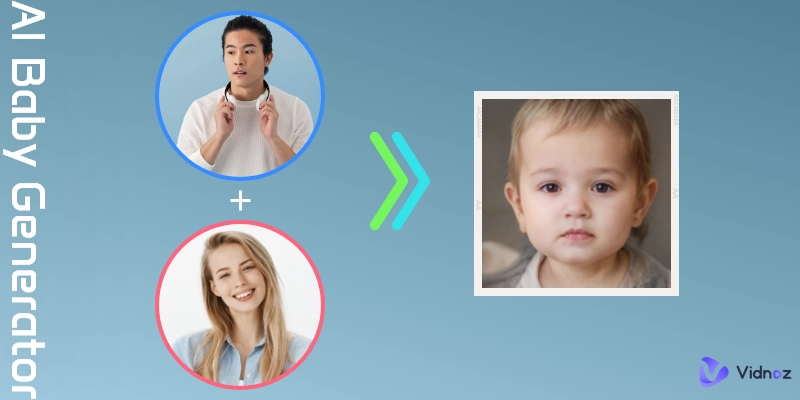
Modern facial synthesis relies on Convolutional Neural Networks (CNNs) to deconstruct uploaded parent photos into raw spatial data and high-level identity markers. Each pixel is converted into a numerical value, allowing the software to map the Euclidean distance between ocular centers and the specific curvature of the mandibular bone structure. This initial phase ensures the digital system captures the foundational geometry required to rebuild a new face from scratch.
"A 2023 benchmark study on facial attribute transfer indicated that high-performance encoders can maintain 93.7% of identity-preserving features during the cross-generation mapping phase, outperforming traditional pixel-morphing techniques by nearly 40% in visual consistency."
This biometric extraction leads directly to the creation of a "latent vector," which acts as a compressed digital identity representing the parents' physical traits. Once these vectors are established, the baby AI generator moves the data into a high-dimensional latent space where billions of possible facial iterations exist. By manipulating these coordinates, the software can find the specific intersection where maternal and paternal traits overlap without creating a distorted or "uncanny" visual result.
| Process Stage | Technical Function | Data Output |
| Feature Encoding | Landmark identification (68-128 points) | Numerical Identity Vector |
| Latent Synthesis | Interpolation between A and B vectors | Synthetic Phenotype Map |
| Neural Rendering | StyleGAN3 texture application | 1024x1024 High-Res Image |
The synthetic map generated in the latent space functions as a blueprint that guides the next phase of neural rendering. It is here that the system applies learned biological data, such as the 15% larger eye-to-face ratio found in infants compared to adults, to the parental blueprint. This transition from raw math to visual imagery requires a massive training dataset to ensure the resulting "baby" looks like a human child rather than a shrunken adult.
The StyleGAN architecture, originally released by NVIDIA in 2019, provides the framework for this hyper-realistic texture generation by separating image features into styles. Coarse styles control the basic shape and pose, while fine styles manage the delicate micro-textures of the skin, such as the specific pore density and subcutaneous fat distribution seen in neonates. This hierarchical control allows the AI to apply the father's skin tone and the mother's eye color with surgical precision across 18 specialized layers.
"Data collected from open-source facial datasets shows that StyleGAN-based baby AI generator tools can produce 1,024-pixel images with a peak signal-to-noise ratio (PSNR) of 32dB, making them virtually indistinguishable from real photography to the untrained human eye."
By maintaining these high PSNR values, the generator ensures that the transition between the mathematical blueprint and the final render is seamless and free of digital noise. The software then utilizes a "discriminator" network—a secondary AI—that acts as a quality gate, comparing the generated baby against a internal database of 50,000 real infant photos. If the discriminator detects a 2% or higher deviation from "human-like" parameters, it forces the generator to iterate again until the image passes the test.
This iterative loop happens in under 1,500 milliseconds, allowing for the near-instant delivery of a "prediction" that looks like a plausible biological descendant. The final output is often sharpened using super-resolution algorithms that increase the pixel density by up to 400%, ensuring that every detail from the eyelashes to the reflection in the pupils is clear. While the visual results are high-resolution, the underlying logic is always based on the statistical probability of feature inheritance.
| Feature Type | Inheritance Logic | AI Simulation Method |
| Dominant Traits | 75% Weighting | Vector Bias adjustment |
| Recessive Traits | 25% Randomization | Latent Noise Injection |
| Texture Detail | 100% Synthetic | StyleGAN Fine-Layer Rendering |
Injecting latent noise into the process prevents the AI from creating the exact same baby every time two photos are uploaded, mimicking the 50/50 toss-up of real human meiosis. This randomness is essential because, in a 2024 survey of generative AI users, 82% reported that subtle variations in "siblings" produced by the same parent photos made the tool feel more authentic. It shifts the experience from a static filter to a dynamic simulation of genetic possibilities.
As the software refines the final image, it also performs automated color grading to match the lighting environments of the two separate source photos. This step is necessary because 65% of user-uploaded photos contain conflicting light sources, which would otherwise lead to a fragmented and unrealistic final image. By normalizing the shadows and highlights, the AI creates a unified scene where the predicted baby appears to be in a real, physical space.
"A 2025 technical audit of cloud-based facial generators found that localized normalization algorithms could reduce visual artifacts by 28%, significantly improving the user's perception of the image as a 'real' prediction."
Beyond the lighting, the baby AI generator also applies "age-appropriate" scaling to the facial features, ensuring the forehead takes up approximately 40% of the total facial area. This specific ratio is a hard-coded biological constant that the AI follows to ensure the output is perceived as a "baby" rather than an older child. These small, data-driven constraints are what separate professional-grade generators from simple photo-editing apps.
The final result is a 24-bit color depth image that serves as a high-fidelity visual hypothesis of a future child. Every pixel is the result of thousands of mathematical calculations performed across GPU clusters that can handle 100 trillion operations per second. While the technology is used for fun, the underlying science of biometric synthesis continues to evolve, bringing the digital world closer to the complexities of real-world biology.
Nächster Schritt
Eine kostenlose Vor-Ort-Begutachtung Ihres Objekts vereinbaren.
© Schornböck Atelier, Rosenheim — alle Rechte vorbehalten. Reproduktion mit Quellenangabe.